
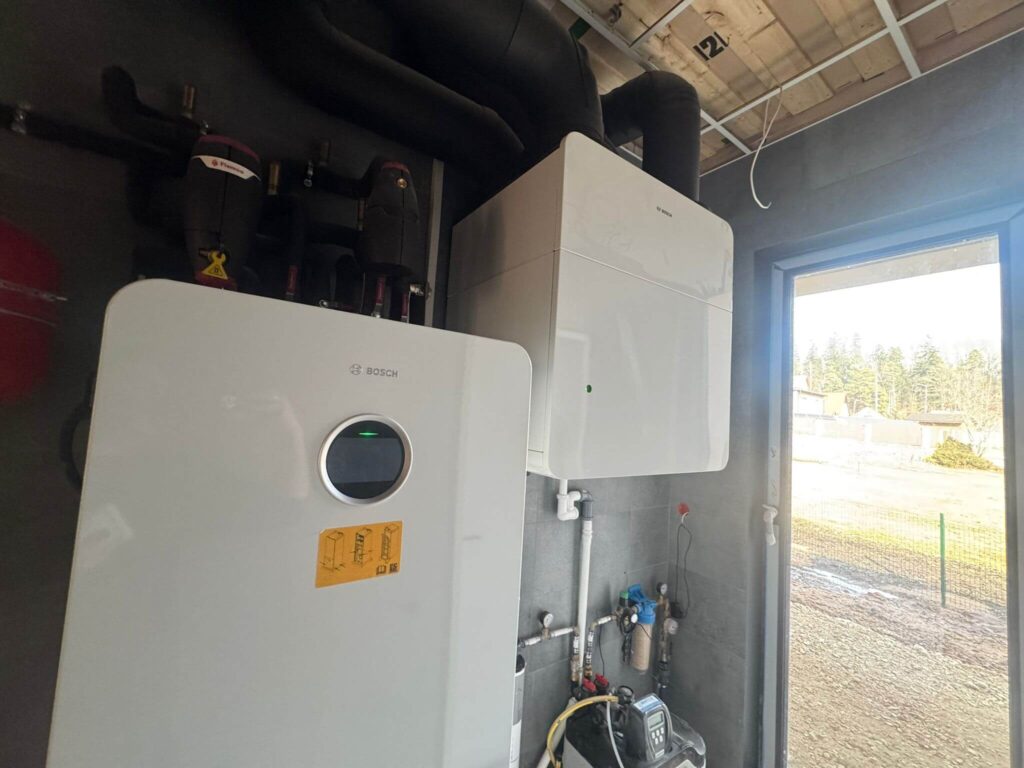
When choosing a heating system for a house or apartment, people increasingly ask themselves – is it really worth choosing a heat pump, or should they stick with proven options such as a pellet stove? This is not only a technical decision – it is also a question of long-term costs, comfort and everyday habits.
The choice between these two solutions largely depends on priorities. If a lower initial investment and a cosy atmosphere matter most, a pellet stove may be the more suitable option.
On the other hand, if the main priority is long-term savings, minimal maintenance and a high level of comfort, a heat pump often turns out to be the smarter choice.
In recent years, the heat pump has become one of the most popular heating solutions, and for good reason. It works by using ambient environmental energy – air, ground or water – thus being able to produce more heat than the electricity it consumes. This means that in the long term this system can be significantly more economical than traditional heating methods. In addition, a heat pump provides a very high level of comfort – it operates automatically and requires no daily supervision. This is especially relevant in modern homes, where not only heat provision matters, but also the overall indoor climate. And no matter where you are, all processes can be reviewed and controlled from a phone app.
Heat pump and pellet fireplace
Comparing a heat pump with a pellet stove or boiler, the biggest difference appears precisely in everyday comfort and in how much you yourself have to be involved in the heating process.
A heat pump essentially works as a fully automatic system — you set the desired temperature, and the rest happens without your involvement. There is no need to think about fuelling, no fuel to carry, no ash or mess. What’s more, it maintains a very even temperature and often also offers a cooling function in summer. In everyday life that means heating becomes an “invisible” background that simply works.
By contrast, a pellet stove or boiler requires regular attention. Although it is more automated than wood heating, you will still need to top up pellets, monitor the appliance and clean out ash – that also means extra mess and time spent.
An important aspect often underestimated in the initial choice is pellet storage. For a pellet stove to work efficiently, pellets must be stored in a dry and ventilated place. That means extra space in the home. On average, the pellets needed for a season can take up around 4 m² or more, if we assume that 4 pallets of pellets are used during the heating season, which when building a new house means additional construction costs and in everyday life – occupied space.
Possibilities with a heat pump
A heat pump is not just a heating appliance – it is a modern, expandable system that can be adapted for even greater efficiency and comfort.
By connecting a heat pump with solar panels, it is possible to significantly reduce electricity costs. By installing room thermostats, the system becomes up to 20% more efficient, as it responds not only to outdoor temperature but also to the actual heat demand in the home.
By integrating a ventilation system, it is possible to supply fresh air without heat loss and control everything from a single control panel. The ventilation unit understands that supply air of a lower temperature than that set on the heat pump must not be admitted. That means not only heat, but also a healthy and comfortable indoor climate all year round.
Costs
Speaking of costs, pellet systems are often cheaper at the time of installation – roughly from 5,000 to 12,000 euros. However, you should also take into account additional costs – purchasing pellets, storage, maintenance and the time you will spend maintaining the system. Annual pellet costs can range around 600 to 1,200 euros or even more, depending on the size of the home and the quality of insulation.
The initial costs of a heat pump are higher – simpler air-to-air solutions can cost around 800 to 4,000 euro, while air-to-water systems already reach 13,000 to 20,000 euro, and ground-source heat pumps may require an investment of as much as 14,000 to 20,000 euro. However, operating costs are often only 300–800 euro per year. This means that in the long term this investment pays off.
What’s more, a heat pump makes you less dependent on fuel price fluctuations, which in recent years have become unpredictable.
Lifestyle choice
From a practical perspective, a heat pump means:
- cleanliness
- quiet operation
- automation
- freedom from everyday worries
Meanwhile, pellet heating means:
- regular involvement
- storage concerns
- more time for maintaining heating
That is why the choice is often not only about price, but about lifestyle. Do you want a system that simply works in your place?
State support – an opportunity to save today
Until 2029 (or while funding is available) it is possible to receive state support under the programme:
“Reducing greenhouse gas emissions in households”
This support makes it possible to significantly reduce initial costs when purchasing:
- heat pump
- solar panels
- other energy-efficient systems
Important: funding is limited and demand is high, so it does not pay to delay.
It is precisely at this stage that many clients decide in favour of a heat pump, because the investment becomes much more affordable.
In the link below, you can familiarise yourself with the support description:
https://lvif.gov.lv/valsts-atbalsts/iedzivotajiem/
Project application:
https://ekii.lv/index.php?page=projekta-iesniegums
The relevance of heating systems over the years
Looking at how heating systems have developed in Latvia, it becomes clear — a heat pump is not just another option, it is the logical next step.
The wood heating era (until ~2000s)
For many years wood heating dominated – stoves, boilers and fireplaces. It was accessible and relatively cheap, but required a lot of involvement – regular stoking, wood supply and physical work. Comfort was low, but there were not many alternatives.
Rise in the popularity of gas (~2000–2020)
As infrastructure developed, gas heating became the comfort standard. Automatic operation, stable heat and minimal involvement made it a popular choice.
But 2022 clearly showed one significant risk – dependence on price fluctuations. Many homeowners experienced a sharp rise in costs.
The pellet-boiler boom (~2010–2022)
Pellet heating became a compromise between firewood and automation. It offered:
- lower costs than gas
- partial automation
- renewable fuel
However, in reality it still requires time, space and regular maintenance. And, as we have seen in recent years – pellet prices can also be unpredictable.
The heat pump era (from ~2020 to today)
We are now living in a time when heat pumps are becoming the new standard. And that is no coincidence.
They combine what previous systems could not:
- high energy efficiency
- full automation
- stable and predictable costs
- minimal maintenance
- an environmentally friendly solution
That is exactly why more and more homeowners in Latvia choose heat pumps — not only as an alternative, but as the smarter long-term solution.
Why choose KlimatsMājai?
Heat pump efficiency largely depends not only on the equipment but also on correct design and installation.
The KlimatsMājai team offers a full service cycle:
- consultation and selection of the most suitable solution
- preparation of an individual offer
- professional installation
- warranty and post-installation service
We install around 140 units a year and have encountered a variety of situations – including complex and non-standard ones. That means we can find the best solution for your home specifically, rather than offering a one-size-fits-all approach.
Our clients appreciate:
- clear communication
- transparent costs
- quality installation
- real results – lower bills and greater comfort
A heat pump is an investment in the future – both financially and in terms of quality of life. It reduces costs, makes everyday life easier and makes the home modern and energy-efficient.
If you want:
- lower heating bills
- more comfort
- fewer everyday worries
then a heat pump is most likely the right choice.
Contact KlimatsMājai today and find out which solution would be most suitable for your home.