
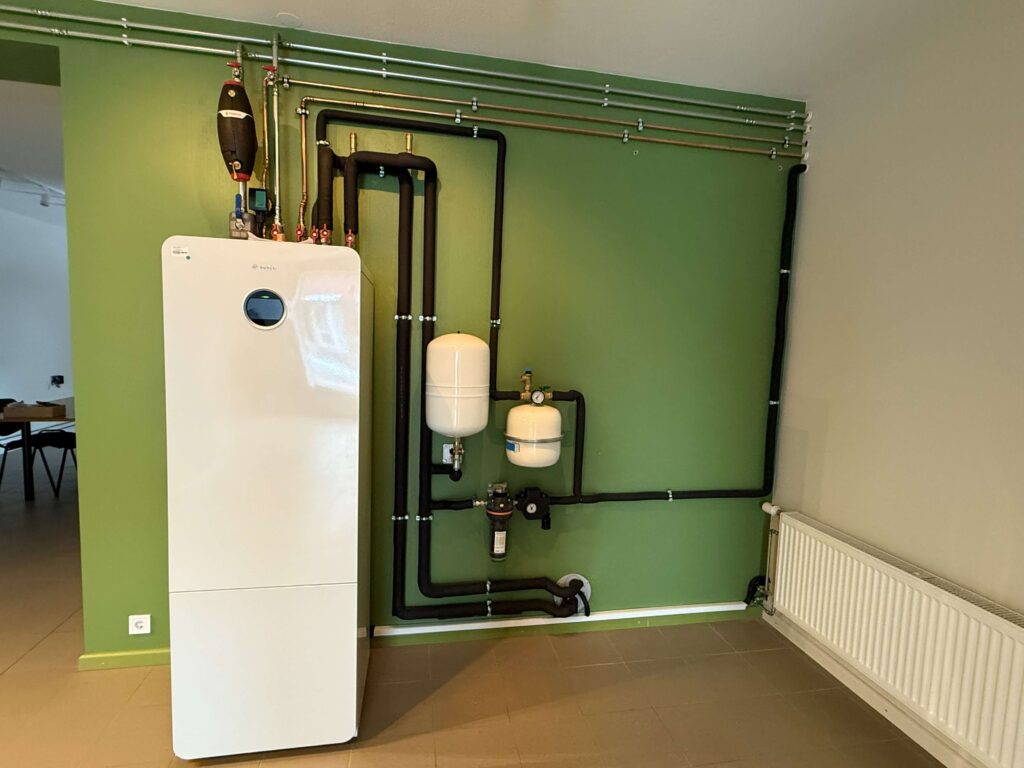
Choosing the right heat pump is one of the most important steps to ensure energy-efficient,
economical and sustainable heating. For the heat pump to work efficiently also in Latvia’s climatic
conditions, it must be adapted both to the building’s heat losses and to the heating system.
Selecting heat pump capacity based on the home’s heat losses
The heat pump is selected based on the home's heat losses. This means that the unit must be able to
produce exactly as much heat energy as the building loses during the heating season.
If the house has previously been heated with pellets, wood or gas, heat consumption can be calculated
very precisely. Using previous fuel consumption, it is converted into heat energy according to a formula and
applies to the heat pump.
These data make it possible to determine the required heat pump capacity based on real consumption, rather than theoretical
assumptions.
For new builds, the energy certificate is used as a basis, which indicates the building's designed heat
losses. This makes it possible to precisely determine what capacity heat pump is needed for the specific building.
Energy certificate – indicates the home’s heat losses according to the planned construction design.
Heating system – radiators, underfloor heating
When choosing a heat pump, it is very important to understand how heat will be delivered to the rooms – radiators,underfloor heating.
Both of these networks have a very significant impact on your home’s heating system and what result
will achieve, because only when both of these systems are built correctly as a set will they work properly.
Radiators
Each radiator at a specific temperature schedule will be able to deliver its heat output.
Each room’s and the building’s total heat consumption must be considered. Based on the manufacturer’s stated
heat output tables, calculate how large the radiators will need to be for each room, as well as
it is possible to vary the types of radiators.
If you want it thinner, it will be longer; you can make it thicker, then it will be shorter. It depends on how
much heat output you want to get from that radiator at a specific heating temperature schedule.
Temperature schedule – heating system fluid flow and return temperatures,
that the heat pump will achieve.
Underfloor heating
Underfloor heating is one of the most efficient heating systems for heat pumps, because it operates with
low flow and return temperatures. Low-temperature heating (30–40 °C)
significantly increases heat pump efficiency and reduces electricity consumption.
It is important to carry out proper underfloor heating installation. Observe the maximum length of a single heating loop so that
flow would be sufficient to heat the floor adequately, because the underfloor heating pipe also has a specific
heat output or watts per metre that each metre of underfloor heating pipe can deliver to your floor.
It is calculated in exactly the same way, taking the room square metres, the room’s heat losses, then looking at what
diameter pipe will be built into the underfloor heating and how many watts per metre it delivers.
Heating system balancing
For heating to work evenly throughout the house, the heating system must be balanced. Without balancing
nearby radiators receive more heat, while those farther away receive less.
Radiator systems use pre-settable valves, while underfloor heating uses distribution
manifolds with flow regulators so that flow can be balanced in each underfloor heating loop, or in each
radiator the maximum flow rate so that there is enough heat for all.
This ensures a comfortable temperature in every room and maximum heat pump efficiency.
Types of heat pumps
Various types of heat pumps are available on the market today – air–to–water, ground-source
(ground–to–water) and air–to–air heat pumps. For heating private homes, the most commonly chosen are
air-to-water heat pumps that provide a good price-to-efficiency ratio, as well as a heat pump
with an integrated hot water tank will be able to replace a boiler.
To install a ground-source heat pump, a large land area is required that would allow installing
horizontal ground loop. This will be about 30% more expensive, but electricity consumption
will be 30% lower compared to an air-to-water heat pump.
Our recommendation would be to choose a heat pump from our partner Bosch, which manufactures
latest-generation heat pumps with propane (R290) refrigerant; it will be more efficient,
more powerful, and accordingly you will be able to choose a lower-capacity unit, because performance will be higher.
SCOP rating – what to look out for
When choosing a heat pump, it is important to pay attention to the SCOP rating.
SCOP – the seasonal average efficiency coefficient, which shows how efficiently the heat pump
will operate throughout the heating season.
It should be noted that manufacturers often specify the W7/35 chart, which means that the stated capacity,
for example, for an 8kw heat pump, at an outdoor air temperature of +7 °C the flow temperature is 35 °C
in the heating system. This indicates a relatively weak result for our climatic conditions, outdoor
when the air temperature drops below +7 °C, or if there is a need for higher
flow temperatures in radiators higher than 35°C, the heat pump's capacity will drop. If you will
has calculated that an 8kw unit is needed for the home, taking a heat pump at this schedule, at
-10°C it will no longer cope with the required capacity and will switch on electric heaters, or electric
heaters, increasing electricity consumption and losing their efficiency.
Summary – how to choose a heat pump correctly
A correctly selected heat pump:
- matches the home’s heat losses
- is coordinated with the heating system
- operates with the lowest possible temperature schedule
- delivers a high SCOP and low operating costs